“Update from Wallops Flight Facility”
Dr. John Degnan, Technical consultant
NASA Goddard Retirees and Alumni Association
“Evolution of Single Photon Lidar: From Satellite Laser Ranging to Airborne Lidars to ICESat-2”
GRAA NEWSLETTER
P.O. Box 1184, Greenbelt, MD 20768-1184
| May 2025 | https://GoddardRetirees.org | 41th Year of Publication |
UPCOMING LUNCHEONS: We meet at 11:15 AM on the 2nd Tuesday of each month at the American Legion Post #136 at 6900 Greenbelt Road. Reservations are required; please contact graalunch@gmail.com (preferred) or call 410-709-8889 before Thursday, May 8th.
| May 13 |
|
Dave Pierce, Director
NASA's Wallops Flight Facility “Update from Wallops Flight Facility” |
| June 10 |
|
Dr. John Degnan, Technical consultant NASA Goddard Retirees and Alumni Association “Evolution of Single Photon Lidar: From Satellite Laser Ranging to Airborne Lidars to ICESat-2” |
COMMENTS FROM TONY COMBERIATE AND CARL STAHLE
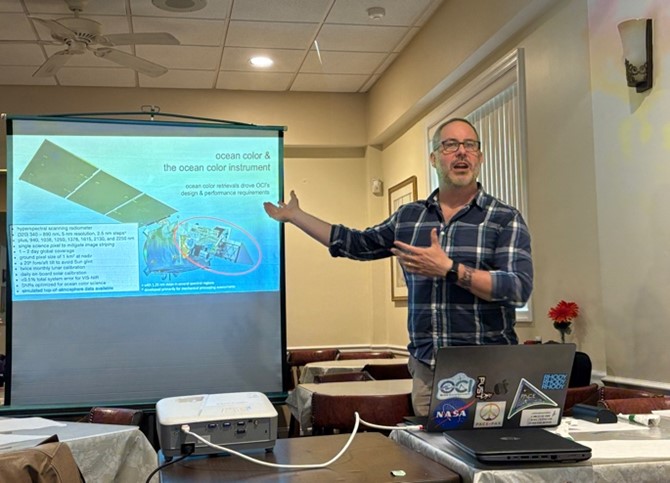
Our April speaker was Dr. Jeremy Werdell, Project Scientist for NASA's Plankton, Aerosol, Cloud Ocean Ecosystem (PACE) mission. Dr. Werdell’s presentation entitled, “Life after launch: A snapshot of the first year of (and brief history of) NASA’s Plankton, Aerosol, Cloud, ocean Ecosystem (PACE) mission,” described the fascinating science discovered during the mission’s first year of operation. Jeremy spoke to us in September 2023 and described the instruments and spacecraft, its heritage in Earth Science missions, and how it would see the invisible (microscopic) stuff from space such as the phytoplankton in water and the aerosols in the atmosphere. Launched on February 8, 2024, the mission has produced groundbreaking results, with all three instruments exceeding their expectations. The mission has already met its baseline mission requirements. Using its enhanced capability, PACE is revolutionizing global marine and atmospheric science with its hyperspectral imaging radiometer and two multi-angle polarimeters. Its advancements in Earth science relative to those from MODIS are as profound as the James Webb Space Telescope advancements over the Hubble Space Telescope.
The primary sensor is the Ocean Color Instrument (OCI) which was built at Goddard which also built the spacecraft. OCI is an optical spectrometer that measures light properties at wavelengths from ultraviolet to shortwave infrared. There are two polarimeters which were both contributed: The Hyper-Angular Rainbow Polarimeter #2 (HARP-2) from the University of Maryland, Baltimore and the Spectro-Polarimeter for Planetary Exploration (SPEXone) from SRON/Airbus. The polarimeters measure aerosol particles and clouds over multiple angles and wide swath to match OCI. Multi-angle polarimetry and tilt adds new measurements that are essential to capture marine system dynamics. Moving from multi to hyperspectral radiometry is essential for observing aquatic systems. With the unprecedented 1-2-day global coverage, PACE is observing the oceans “breathing” as the plankton changes.
Jeremy showed fascinating pictures and videos of PACE data products detailing aerosol absorption, cloud optical height, depth, and thickness, Cloud distributions and shapes, ocean reflectance, oil slick images, and even recent fire damage in California.
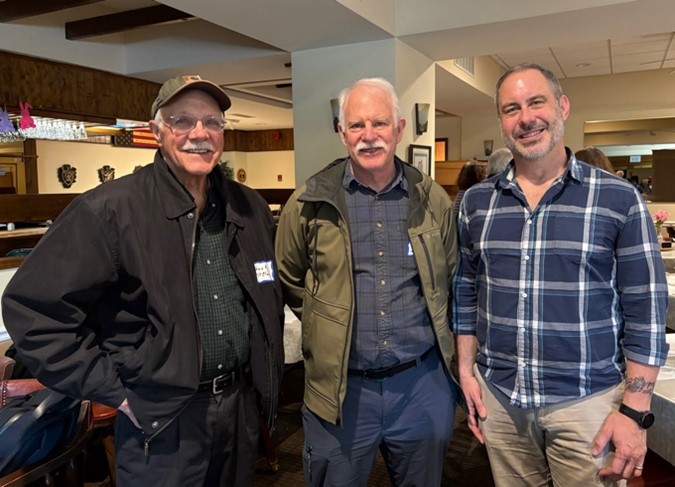
We were delighted to have Chuck McClain, Jim Irons, and Jeremy Werdell at the lunch. They embody Goddard’s leadership as Project Scientists for SeaWiFS (Chuck), Landsat 8 (Jim), and PACE (Jeremy).
GRAA is on Social Media
With the encouragement of Dr. Makenzie Lystrup, Goddard’s Center Director, GRAA has extended its reach to social media. We are now on LinkedIn which is the world’s largest professional network. Members can visit linkedin.com and search for NASA Goddard Retirees and Alumni Association. You are welcome to be a follower of this group.
WELCOME TO NEW MEMBERS:
We are delighted to welcome the following new members:
Lily Bashar
Mary Collins
John Cooper
David Gaylor
Dorothy (“Dee”) Kerr
Randal Koster
Mike Krainak
Dan Krieger
Jacqueline Le Moigne
Linda Ledman
Michael Menzel
Jay Pittman
Pam Pittman
Cheryl Salerno
ACTIVITIES FOR MEMBERS:
Jan Kalshoven, one of GRAA’s board members, became the president of what is now called the Goddard Tennis and Pickleball Club (GTPC) this past year. There are no fees to play at the Goddard Tennis complex which now has lines and a rollable net for pickleball (Access to the center is by showing your Goddard retiree badge as you drive in). Courts are open to all, but if you want to join GTPC and get on WhatsApp and TeamReach to find other Goddard players, send an email to .
WHAT’S UP WITH OUR MEMBERS:
We are starting a new section in our monthly newsletter for members to give us short updates on their lives since retirement from Goddard and federal service. We thought your colleagues would enjoy hearing about your life experiences after Goddard before they see your name in our “Remembering Our Former Colleagues” section. News of interest to our members could be professional, volunteer activities, awards and recognition, a personal achievement, or an unusual adventure or hobby. Please feel welcome to send a concise message (<100 words) to Tony Comberiate () and Carl Stahle () who reserve the right to edit for content and length.
Mike Calabrese retired from Goddard in 2003. He continued his support of the AAS Goddard Memorial Symposium Planning Committee through 2019. He also continued his volunteer activities as a Boy Scouts of America Adult Leader, a McLean Youth Soccer coach and referee, and a member of the National Ski Patrol. Mike and his wife decided to move to Colorado in 2021 where they have enjoyed being near family while skiing, hiking, and backpacking in the mountains. He misses the GRAA luncheons and looks forward to attending the June 10, 2025, luncheon during a visit to the Washington area.
Sharon Garrison retired in 2015. She performed in a tap dance show at the Kennedy Center’s Millennium Stage and in the NJ Tapfest. Sharron has traveled extensively: bird watching in Costa Rica; visiting friends in Ireland; chasing cherry blossoms throughout Japan; followed the Great Migration in Tanzania; visited Zanzibar, Saudi Arabia, Bali (Indonesia), Paris (France), Denmark, Norway, Sweden, Morocco and Assisi (Italy); and drove cross country to New Mexico. She has made a lot of art: learned to draw, use color pencils, watercolor, acrylic paint, pastels, sculpture, made a lot of fiber arts and worked with Japanese paper. She has studied Jungian psychology.
John Peake retired in April 2003. He and Camille moved to Granite Falls, North Carolina just outside of Hickory in 2011. John volunteered in the Civil Air Patrol as a check and instructor pilot until 2023. The FAA awarded John the Master Pilot Award in 2017. John enjoyed his time at Goddard working on the TDRS program. John is a Navy veteran who worked many years at the Naval Surface Weapons Center in White Oak, Maryland until 1991 before coming to Goddard.
DIRECTORIES AND NEWSLETTERS. Send your email address to goddardretirees@gmail.com to get our monthly Newsletters, which include synopses of the talks, special community announcements, and obituaries. Past Newsletters and links to videos of the talks are on our website https://goddardretirees.org. Multi-month abstracts of Newsletters are mailed to the retirees with only residential addresses in our files. We depend on retirees to furnish their home addresses to be listed in the biennial GRAA Membership Directories, only available as mailed hardcopies to members. These mailings are supported by donations to GRAA, P. O. Box 1184, Greenbelt, MD 20768-1184.
TREASURER’S REPORT: Jackie Gasch received donations from: Howard Pedolsky and Ellen Herring.
FROM THE GODDARD ARCHIVES:
On May 23, 1995, Atlas I launched GOES J (GOES 9) into geosynchronous orbit. It was the 2nd satellite of the 2nd generation. For two years (2003 – 2005), it was provided to Japan as a replacement for the failed GMS-5. It was retired in 2007 and boosted to a graveyard orbit
REMEMBERING OUR FORMER COLLEAGUES
Edward Owen Brigham, 86, of Manchester, New Hampshire died on April 18, 2025. Edward was born in West Stewartstown, New Hampshire on April 24, 1938, and grew up in Colebrook, New Hampshire. He served as an Army specialist in the 526th Missile Battalion, stationed in Germany from 1957 to 1960. He earned an Industrial Electronics degree from New Hampshire Vocational Technical College and worded as a flight tracker at Goddard.
Richard J. Driscoll, Jr., 78, died peacefully on March 28, 2025, in Bowie, Maryland. Richard was born on September 18, 1946, and grew up in Providence, RI. After receiving his PhD in Mechanical Engineering from SUNY Buffalo, he served four years in the Air Force achieving the rank of Captain. In 2008, he joined Goddard as a Propulsion Engineer where he worked on the Europa Clipper.
Margaret Elizabeth Gottschalk, 81, died on April 1, 2025. She was. born on July 15, 1943, in Whitewater, Wisconsin and served in the U.S. Navy from 1963 to 1966 as a data processing technician. Margaret worked at Goddard and served as an ombudsman for the U.S. Naval facility in Brawdy, Wales.
Marilyn Joyce Power Mack, 81, of Loudon, Tennessee, died on April 15, 2025. She was born in Queens, New York. She earned both a master's degree and a Doctor of Science degree in computer science from The George Washington University. Marilyn was a professor of mathematics at Loyola University, Maryland, before becoming a mathematical analyst for Westinghouse. Later, she joined Goddard as a computer programmer on the Landsat satellite project. She also was a director of student enrichment programs, which focused on inspiring and supporting students interested in or already pursuing careers in science and technology. While working at Goddard, she also taught programming at Capitol Technology University. Marilyn retired in 2012.
Charles “Chuck” Mason, 96, died on March 5, 2025. Chuck was born on December 15, 1928, in Boston, Massachusetts, and sailed to ports around the world from 1946 to 1948 as an Able-Bodied Seaman in the U.S. Merchant Marine. He served in the Massachusetts National Guard during the Korean War. Chuck graduated from Northeastern University in 1954 with a Bachelor of Science degree in electrical engineering and worked as an electronics engineer for MIT Lincoln lab, the FAA, and retired from Goddard in 1988 after 28 years in the manned space flight and satellite remote sensing programs. Chuck was an active aviator and aircraft owner for over 75 years.
Brian Lynn Rodbell, 74, was born on February 20, 1951, in Washington, D.C. Brian dedicated much of his professional life to advancing science and technology. As a Network Systems Administrator at Goddard, his technical expertise and unwavering commitment secured the resources necessary to maintain and create reliable operations and critical missions that contributed to the exploration and expansion of the use of space.
Locke McKinnon Stuart Jr, 88, of Weddington, North Carolina, died April 5, 2025. He was born in Hagerstown, Maryland, on November 22, 1936. He graduated with a bachelor’s degree in English from the University of Maryland and worked at Goddard for over 40 years.
Robert Lee "Bob" Wilson, Jr., 89, died on March 23, 2025. Bob was born on June 27, 1935, in Washington, D.C. and grew up in Brentwood, Maryland before serving in the United States Army from 1955 to 1958, specializing in electronics and radar systems, with several deployments most notably Thule, Greenland. His professional career spanned decades in electrical engineering including Goddard, and then at the University of Maryland, where he spent over two decades helping students apply advanced electronics to their chemical, electrical, and nuclear projects and experiments.
Robert Edwin (Ed) Smylie, 95 died on April 21, 2025. Ed was born on December 25, 1929, in Lincoln County, Mississippi. After service in the US Navy, he graduated from Mississippi State University with a bachelor’s and a master’s degree in mechanical engineering. He joined the Douglas Aircraft Company where he participated in the development of the DC-8. When President Kennedy announced in 1962 plans for a manned mission to the Moon, he applied and was accepted for a position with NASA as head of the Environmental Control Section.
Ed spent the next 11 years at the Johnson Space Center, where he designed and developed the environmental control systems for the Apollo program including the spacecraft and spacesuits used on all Apollo Lunar Missions. In 1967, he was selected to attend the Sloan Fellowship program at MIT graduating with a master’s degree in management. He later served as chairman of the working group responsible for the development of the environmental systems for the joint US-Soviet Apollo-Soyuz mission.
The world held its breath during the Apollo 13 mission as the astronauts and ground support wrestled with seemingly intractable problems. One such problem concerned the CO2 scrubbers used on the command module and lunar module. The two systems used filters that were not interchangeable, and when the entire crew moved into the lunar module, its scrubbing system lacked the capacity to provide breathable air. Ed and two colleagues stepped into the breach to engineer a device that adapted the command module’s scrubbers using only what was available to the crew – among other things a sock, the flight plan binder, hoses from their suits, and duct tape. He later stated that once he learned that duct tape was available, “I felt like we were home free; one thing a southern boy will never say is ‘I don’t think duct tape will fix it.’”
In 1973, he moved to NASA Headquarters and then in 1976 moved to Goddard as the Deputy Director. At Goddard, he led the development of the Tracking and Data Relay Satellite System (TDRSS). In 1980, he returned to NASA Headquarters as Associate Administrator for Space Tracking and Data Systems with responsibility for NASA’s worldwide satellite tracking network and NASA communication systems and for data acquisition from satellites.
Ed was an integral contributor at NASA through the early phases of the space shuttle program and was recognized at a White House luncheon for his role in the program. After retiring from NASA in 1983, he joined RCA as Vice President for Government Communication Systems and in 1988, joined MITRE Corporation as Division Director for NASA Business.